EN




What Is Deodorant Roll-On Packaging and How Does It Work?
 HONGDA
 2026-10-23
Roll-on deodorant packaging stores a deodorant formula in a bottle and applies it through a rotating ball held in a fitment. As the wetted ball turns against the underarm, it transfers a thin film of product onto the skin. The bottle, ball, fitment and cap work together to control dispensing during use and sealing during storage.
For a brand developing a new deodorant, the useful question is how that complete system behaves with the intended formula. A bottle can look right on a shelf while its rolling feel, output or sealing still needs attention. Start with the mechanism, then evaluate the assembled pack.

The four parts of a roll-on pack
A common roll-on pack has four components. Each has a different job, and the interfaces between them deserve as much attention as the individual parts.
|
Component |
Main role |
What to check |
|
Bottle |
Contains the formula and feeds it toward the applicator. |
Bottle-neck dimensions and compatibility with the selected components. |
|
Roll-on ball |
Carries product to the skin as it rotates. |
Diameter, roundness, surface condition and rolling resistance. |
|
Housing or fitment |
Retains the ball and controls its working clearance. |
Fit with the bottle neck, ball movement and sealing surfaces. |
|
Cap |
Closes the pack for storage. |
Closure torque and the design’s sealing contact or compression. |
Bottles may use PP, PE, PET or glass. Fitments commonly use PE or PP, while caps generally use PP. The deodorant roller ball can be plastic or stainless steel. Check the drawing and bill of materials for the actual combination rather than assuming every pack uses the same resin throughout.
Packaging can be sourced as a complete set or as separate components. When replacing only the ball or fitment, make the existing bottle-neck drawing and physical samples part of the discussion. A component name alone is not a matching specification.
How the ball transfers deodorant
The ball sits partly inside the pack and partly outside it. The inner surface contacts the formula. During application, rotation carries that wetted surface outward, where it releases a thin film onto the underarm. The fitment holds the ball in position while allowing it to turn.
The moving surface is doing the transfer work. As the ball continues to rotate, another wetted section reaches the application area. The fitment therefore has two linked responsibilities during use: retaining the ball and leaving the clearance needed for that transfer.
The clearance between ball and fitment is central to this action. Too little clearance can increase rolling resistance or cause sticking. Too much can allow excessive output and leakage. A smoothly turning ball and a controlled flow therefore need to be evaluated together.
This is why the ball diameter should not be selected in isolation. A change that makes rotation easier can also change the dispensing clearance. Ask for the ball and fitment to be considered as a matched combination, then judge the result in the assembled bottle.
Viscosity is part of the same problem. Ball diameter, fitment diameter and surface friction need to be considered together for different formulas. Test how readily the ball starts moving and how much product it delivers during continued rolling, using the intended formula and relevant application angles.
How the pack seals when closed
In some designs, tightening the cap presses the ball against an annular sealing area. Removing the cap releases that closed condition and leaves the working clearance needed for dispensing. Other structures use different sealing contacts, so confirm the mechanism for the selected pack.
Storage sealing depends on several interacting features, including cap pressure, the fitment lip, bottle-neck roundness and closure torque. Checking the cap alone will not explain every leak. Inspect the assembled system and how its components contact one another.
If leakage appears, separate the questions. Is the ball-to-fitment clearance appropriate? Does the fitment sit correctly in the neck? Does the cap reach its intended sealing contact? These checks keep the investigation focused on the working interfaces instead of treating every leak as a faulty bottle.
Include both closed-pack storage and open-pack dispensing in the sample review. A pack that passes a static leakage check still needs functional testing for rolling resistance and output. Likewise, pleasant application does not establish that the closed pack will withstand the planned storage and transport conditions.
Why the formula changes the packaging decision
One roll-on bottle should not be treated as suitable for every deodorant formula. Viscosity, flowability, surface tension, chemical composition and temperature can affect performance. A successful water test does not establish compatibility with the finished product.
Poor output also deserves a broader check. A thick formula may contribute, but tight component fit, assembly problems or dried product can produce similar symptoms. Compare the formula and the physical assembly before requesting a different ball size. A symptom by itself does not identify the cause.
Before choosing samples, define the target amount per use, preferred rolling feel, filling volume and direction of application. Share relevant formula information, including viscosity and ingredients that may influence material selection. These inputs make the sample discussion specific enough to guide testing.
When reviewing roll-on bottle materials and sizes, use capacity and material as initial filters. The next decision is the complete component combination and its behaviour with your formula. An attractive bottle profile cannot settle that question.
Compatibility checks can include exposure to the actual formula and observations of dimensional changes, stress cracking, odour or colour migration. Select the relevant checks for the materials and formulation involved. Keep the observations tied to the exact samples tested.
Review all formula-contact components, including the ball and fitment. The bottle material alone does not describe the complete pack, because the components may use different resins. Keep the final drawing and bill of materials beside the compatibility results so the tested combination remains identifiable.
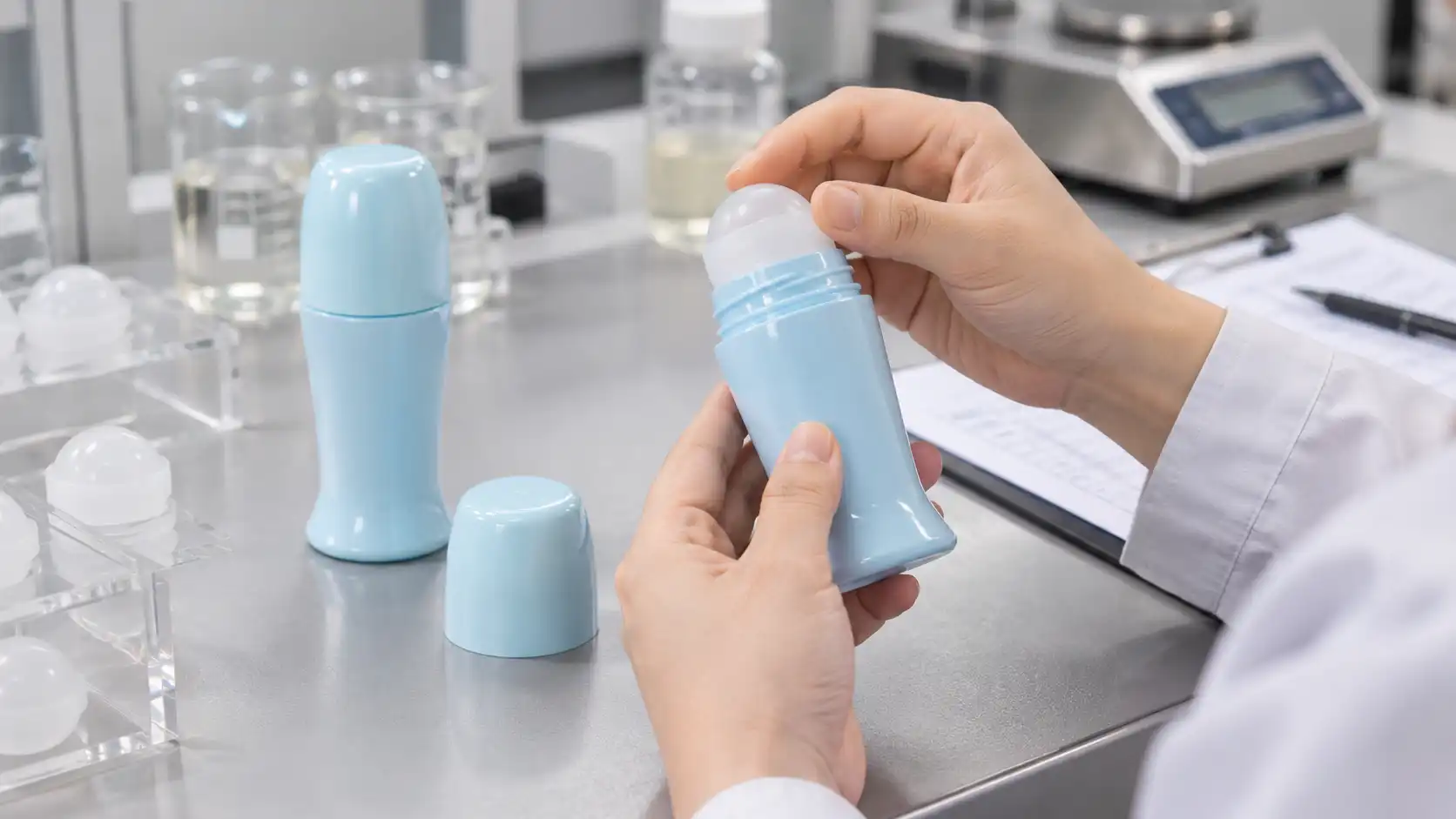
What to check before approving samples
Use the actual formula and expected filling volume for the main evaluation. If the formula cannot be shipped, provide its viscosity, density and type, together with a video showing how it flows. Treat that information as the starting point for sample selection.
- Check start-up and continued rolling, dispensing amount, and behaviour at relevant angles and pressures.
- Storage and transport. Evaluate side and inverted storage, opening and closing cycles, and appropriate temperature, vibration, drop or pressure conditions.
- Material compatibility. Check the formula-contact components for relevant changes after exposure to the actual product.
- Filling and assembly. Review fitment insertion, ball assembly, cap-closing torque, contamination around the filling area and leakage after assembly.
Agree on the test conditions and acceptance criteria before comparing samples. Record the formula, component combination, fill quantity and observations together. This gives the approval discussion a clear reference instead of relying on a general impression that a sample feels good.
For example, a sample-review sheet can place rolling resistance, dispensing amount, leakage observations and opening or closing torque alongside the relevant temperature and storage orientation. Use that record to compare candidate combinations. Define the required conditions for your project rather than copying an unrelated test duration or numerical limit.
Hongda supplies complete roll-on packaging sets and individual components. To discuss a suitable starting point, send your formula details and packaging requirements, including the intended filling volume and any existing bottle or component drawings.
FAQ
Why does a roll-on ball stop turning smoothly?
Possible causes include a tight ball-to-fitment match, a deformed fitment, a viscous formula, crystallisation, incorrect assembly or dried residue. Check the actual filled sample before deciding which part needs to change.
Does passing a water leak test mean the pack is ready?
No. Water does not represent every deodorant formula. The finished product’s flow, surface tension, chemistry and behaviour at different temperatures can change the result. Validate the selected pack with the intended formula.
Can a roll-on deodorant bottle be refillable?
Refill systems can use a durable outer case with a replaceable inner bottle or cartridge. Evaluate refill hygiene, residue, user operation and ball or fitment service life. Do not assume that an ordinary bottle is designed for repeated opening and refilling.
Why are some roll-on packs stored upside down?
In a pack designed for inverted storage, the formula stays in contact with the ball, helping dispensing. That arrangement also makes long-term inverted testing and component matching important. Confirm the intended storage orientation for the chosen design.